Commercial RO System: Benefits, Capacity, Price & Business Guide
Clean and reliable drinking water is an important requirement for offices, hotels, restaurants, hospitals, schools, factories, and other commercial facilities. When water is required for multiple users every day, a domestic RO purifier may not provide the required capacity or continuous operation.
This is where a Commercial RO System becomes useful. Commercial RO systems are designed to treat larger quantities of water and can be configured according to the quality of the incoming water, required capacity, storage, and application.
For businesses, choosing the right RO system is not only about the initial purchase price. Water quality, purification capacity, installation, electricity consumption, maintenance, filter replacement, and after-sales service are also important.
This guide explains what a commercial RO system is, how it works, its types, capacity, applications, maintenance, price factors, and business opportunities.
What Is a Commercial RO System?
A Commercial RO System is a reverse osmosis water purification system designed for commercial and institutional applications where the water requirement is higher than that of a typical household.
The system uses pressure to pass water through an RO membrane. Depending on the source-water quality and system configuration, additional filtration stages may be used before and after the RO membrane.
Commercial RO systems can be used in:
- Offices
- Hotels
- Restaurants
- Hospitals
- Schools and colleges
- Factories
- Shopping complexes
- Commercial buildings
- Institutions
The capacity and configuration should be selected according to the water source and daily requirement.
How Does a Commercial RO System Work?
A commercial RO system generally works through multiple treatment stages.
Step 1: Water Inlet
Water enters the purification system from a suitable source, such as:
- Borewell
- Municipal supply
- Storage tank
- Water tanker
The source water should ideally be tested before finalizing the treatment design.
Step 2: Pre-Treatment
Pre-treatment protects the RO membrane and improves system performance.
Depending on the water quality, the system may include:
- Sand or multimedia filtration
- Sediment filtration
- Activated carbon filtration
- Micron filtration
- Water softening or antiscalant treatment
The exact pre-treatment depends on the contaminants and characteristics of the source water.
Step 3: RO Purification
A high-pressure pump sends the pre-treated water through the RO membrane.
The membrane helps reduce dissolved salts and various contaminants from the feed water.
Step 4: Treated Water Storage
The purified water can be stored in a suitable tank before being supplied to the required points.
Step 5: Water Distribution
Treated water can then be supplied to:
- Drinking water points
- Kitchens
- Dispensers
- Storage tanks
- Other suitable applications
Why Is a Commercial RO System Important for Businesses?
Commercial facilities often require a consistent supply of treated water. Depending on the source, untreated water may contain high TDS, suspended particles, hardness, unpleasant taste, or other contaminants.
A properly designed commercial RO system can help businesses manage these water-quality concerns.
Key advantages include:
- Higher purification capacity
- Centralized water treatment
- Consistent treatment when properly maintained
- Reduced dependence on packaged drinking water
- Suitable for multiple users
- Planned maintenance and servicing
However, RO should not automatically be considered necessary for every water source. Water testing is important before selecting the treatment technology.
Commercial RO vs Domestic RO
One of the most common questions is the difference between domestic and commercial RO systems.
Domestic RO
Domestic RO systems are generally designed for:
- Homes
- Small families
- Lower daily water consumption
- Limited operating requirements
Commercial RO
Commercial systems are designed for:
- Offices
- Hotels
- Restaurants
- Schools
- Hospitals
- Commercial facilities
- Higher water requirements
They generally offer higher production capacity and are designed for more demanding operating conditions.
The correct choice depends on the required water quantity and application rather than simply choosing a larger system.
Types of Commercial RO Systems
Commercial RO systems are available in different configurations.
Wall-Mounted Commercial RO
Wall-mounted systems can be useful where floor space is limited.
They may be suitable for:
- Small offices
- Clinics
- Shops
- Institutional areas
Floor-Mounted Commercial RO
Floor-mounted systems are suitable for locations requiring higher capacity and sufficient installation space.
They can be used in:
- Hotels
- Hospitals
- Factories
- Schools
- Commercial buildings
Cabinet-Type Commercial RO
Cabinet-type systems enclose the main components within a structured body. They provide a cleaner appearance and can be suitable for commercial environments where equipment presentation is important.
Higher-Capacity Commercial RO
Facilities with greater water requirements may need higher-capacity systems with suitable pre-treatment, storage, pumping, and distribution arrangements.
Commercial RO Capacity Explained
Capacity is one of the most important factors when selecting an RO system.
Capacity is commonly expressed in LPH (litres per hour).
Commercial systems can be available in different capacities, such as:
- 25 LPH
- 50 LPH
- 100 LPH
- 250 LPH
- 500 LPH
- Higher-capacity configurations
The required capacity depends on:
- Number of users
- Daily water consumption
- Peak demand
- Operating hours
- Storage capacity
- Water source
For example, a small office may require a completely different system from a hotel or large manufacturing facility.
Choosing capacity based only on the lowest price can result in insufficient water availability or unnecessary equipment costs.
Where Are Commercial RO Systems Used?
Commercial RO systems are used across a wide range of applications.
Hotels and Restaurants
RO-treated water may be used for drinking, food preparation, kitchens, and other suitable applications.
Offices and Corporate Buildings
Commercial RO systems can provide treated water for employees, visitors, and pantry areas.
Hospitals and Healthcare Facilities
Water-treatment requirements can be particularly important in healthcare environments. The system should be selected according to the facility's specific water-quality and operational requirements.
Schools and Colleges
Commercial RO systems can provide treated water for students, teachers, and staff.
Factories and Industrial Facilities
Factories may require drinking water for employees and workers and can select a system based on their workforce and daily consumption.
Shopping Malls and Commercial Complexes
Commercial RO systems can support drinking-water requirements in food courts, staff areas, and other suitable locations.
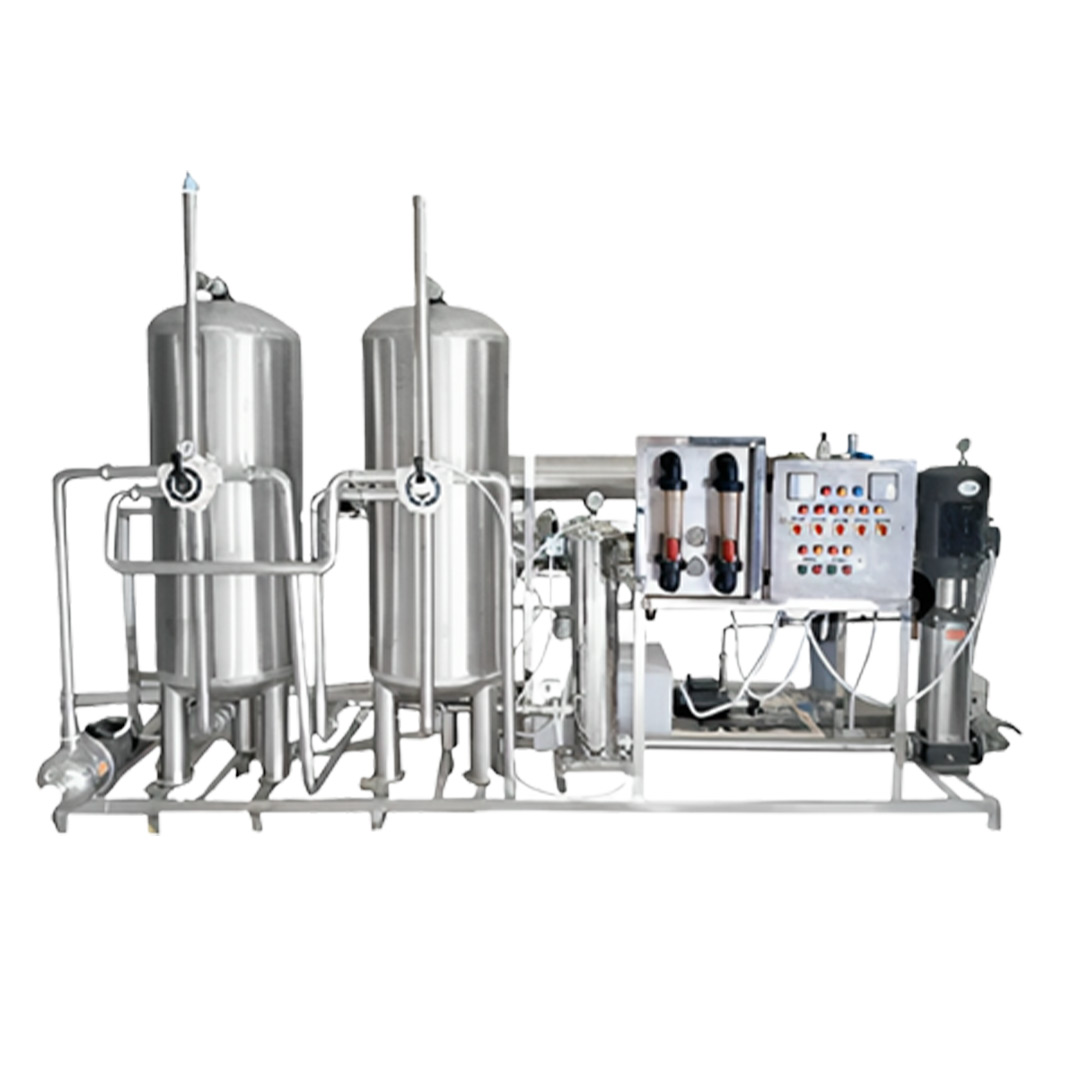
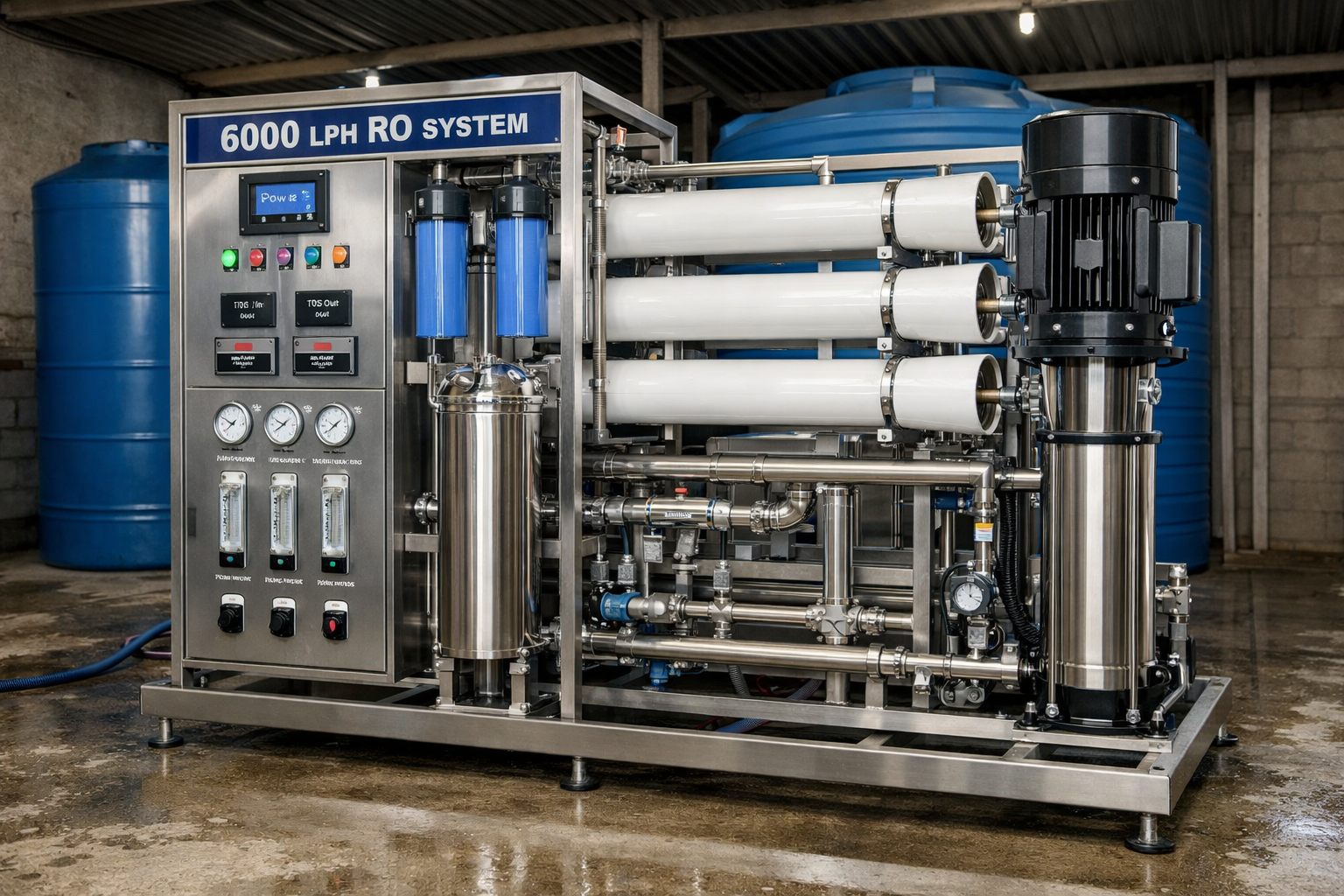
Main Components of a Commercial RO System
A commercial RO system may contain several components depending on the design.
Common components include:
- Feed water pump
- Pre-treatment filters
- Sediment filter
- Activated carbon filter
- Micron filter
- High-pressure pump
- RO membrane
- Pressure gauges
- Control panel
- Flow meters
- Storage tank
- Piping and valves
Larger systems may require additional pre-treatment and monitoring equipment.
Importance of Water Testing Before Installation
Water testing should be an important part of commercial RO planning.
A water test can provide information about:
- TDS
- Hardness
- pH
- Turbidity
- Iron
- Other relevant contaminants
This information helps determine the appropriate purification process and pre-treatment requirements.
Skipping water testing can result in incorrect equipment selection, higher maintenance requirements, membrane scaling, or poor system performance.
Installation Process of a Commercial RO System
A typical installation may include:
- Site inspection
- Source-water testing
- Capacity calculation
- Equipment selection
- Pre-treatment installation
- RO system installation
- Plumbing connections
- Electrical connections
- System testing
- Basic operator training
Professional installation helps ensure that the equipment operates according to its intended specifications.
Maintenance of Commercial RO Systems
Regular maintenance is essential for reliable performance.
Typical maintenance activities include:
- Filter replacement
- RO membrane inspection
- Pressure monitoring
- Pump inspection
- Leakage checking
- Tank cleaning
- Pipe and valve inspection
- Electrical system inspection
- Membrane cleaning when required
Maintenance frequency depends on source-water quality, daily usage, system design, and manufacturer recommendations.
Common Commercial RO Problems
Low Water Production
Possible causes include:
- Clogged filters
- Low feed pressure
- Membrane fouling
- Pump problems
The complete system should be inspected to identify the actual cause.
High TDS in Treated Water
Possible causes may include:
- Membrane performance issues
- Incorrect operating conditions
- Membrane damage
- Poor pre-treatment
Regular TDS monitoring can help identify changes in system performance.
Frequent Filter Blockage
This may indicate high suspended solids or inadequate pre-treatment.
Improving the pre-treatment stage may help reduce the problem.
Pump Problems
A faulty or poorly maintained pump can affect system pressure and production.
Regular inspection and servicing can help identify pump-related issues.
Commercial RO Running Cost
The operating cost of a commercial RO system depends on several factors.
Major cost areas include:
- Electricity
- Filter replacement
- Membrane replacement
- Chemicals where applicable
- Water consumption
- Maintenance
- Spare parts
- Operator requirements
The actual operating cost varies according to the capacity, water quality, operating hours, and system configuration.
Commercial RO Price in India
The Commercial RO price varies significantly because commercial systems are available in different capacities and configurations.
Factors affecting price include:
- RO capacity
- Pre-treatment system
- Number and type of membranes
- Pump specifications
- Storage capacity
- Construction material
- Automation level
- Control panel
- Installation requirements
- Warranty
- After-sales service
Instead of comparing only the purchase price, buyers should compare the total cost of ownership, including installation, electricity, maintenance, filters, membranes, and service.
How to Choose the Right Commercial RO System
Before purchasing a commercial RO system, consider these factors:
1. Test the Water
Identify the quality and contaminants in the source water.
2. Calculate Daily Requirement
Estimate actual water consumption rather than choosing capacity based on guesswork.
3. Consider Peak Demand
The system should be able to meet periods of higher consumption.
4. Select the Correct Capacity
Choose the appropriate LPH capacity according to the water requirement.
5. Check Available Space
Consider space for the RO system, pre-treatment, storage tanks, and maintenance access.
6. Consider Maintenance
Check the availability and cost of filters, membranes, pumps, and spare parts.
7. Evaluate Service Support
Reliable technical support can be important for commercial installations.
8. Compare Total Cost
Consider the purchase price along with installation and long-term operating expenses.
Commercial RO as a Business Opportunity
The commercial water purification market can provide opportunities for suppliers, installers, distributors, and service providers.
Businesses can potentially generate revenue through:
- Commercial RO system sales
- Installation services
- Filter replacement
- RO membrane replacement
- Spare parts
- Annual Maintenance Contracts (AMC)
- Repair and servicing
However, commercial RO is not automatically a guaranteed or “risk-free” business. Success depends on local demand, competition, pricing, product quality, technical expertise, marketing, and after-sales service.
Investment Required to Start a Commercial RO Business
The investment depends on the business model.
A small operation may initially require:
- Supplier or manufacturer relationships
- Installation tools
- Basic spare parts
- Marketing budget
- Service equipment
- Transportation arrangements
Businesses can expand gradually by adding:
- Commercial RO sales
- Installation
- AMC services
- Spare parts
- Water testing
- Large institutional projects
Strong technical support and good customer service can help generate repeat business and referrals.
Direct Business Outreach
Approach:
- Hotels
- Restaurants
- Schools
- Hospitals
- Offices
- Factories
- Commercial complexes
Partnerships
Build relationships with:
- Plumbers
- Contractors
- Facility managers
- Builders
- Electrical contractors
- Water-treatment professionals
After-Sales Service
Reliable maintenance and quick service can help turn existing customers into repeat customers and referrals.
Future Demand for Commercial RO Systems
Demand for commercial water-treatment systems may continue to be influenced by:
- Increasing awareness of water quality
- Growth of commercial facilities
- Higher demand for treated drinking water
- Expansion of hotels and restaurants
- Institutional infrastructure development
- Need for reliable on-site water treatment
As commercial facilities continue to look for practical water-treatment solutions, appropriately designed RO systems are likely to remain an important option for many applications.
Frequently Asked Questions
What is a Commercial RO System?
A Commercial RO System is a reverse osmosis water purification system designed for businesses and institutions with higher water requirements than typical households.
What is the difference between commercial and domestic RO?
Commercial RO systems generally have higher capacities and are designed for more demanding usage. Domestic RO systems are intended for household-level water requirements.
What capacity of Commercial RO is suitable?
The required capacity depends on daily consumption, number of users, peak demand, operating hours, and storage requirements. Water consumption should be calculated before selecting an LPH capacity.
How much does a Commercial RO System cost in India?
Commercial RO prices vary according to capacity, membranes, pumps, pre-treatment, storage, automation, construction, installation, and service requirements.
Is water testing necessary before installing a Commercial RO?
Water testing is strongly recommended because it helps determine the appropriate treatment stages and equipment configuration.
How often does a Commercial RO require maintenance?
Maintenance frequency depends on water quality, usage, system design, and manufacturer recommendations. Filters and membranes should be inspected and replaced or serviced as required.
Can Commercial RO systems be used in hotels and restaurants?
Yes. Commercial RO systems can be used in hotels and restaurants for suitable drinking and food-service applications, provided the system is correctly sized and designed for the source water.
Conclusion
A Commercial RO System can be an effective water-treatment solution for offices, hotels, restaurants, hospitals, schools, factories, and other commercial facilities with regular treated-water requirements.
The right system should be selected based on water quality, daily consumption, capacity, pre-treatment, available space, installation requirements, maintenance, and total operating cost.
For entrepreneurs, commercial RO can also provide opportunities in equipment sales, installation, maintenance, spare parts, and AMC services. However, long-term success depends on providing suitable products, accurate technical guidance, competitive pricing, and dependable after-sales support.
If you are looking for a Commercial RO System for your business or institution, explore AquaSoft RO's commercial RO solutions and evaluate the specifications according to your water source and daily requirement.